

Is your chemical first aid fit for purpose? A 10-point checklist
Most sites have chemical first aid in place. Fewer have checked it against the risks they actually face, the European standard for emergency showers and eyewash (EN 15154), or the latest evidence. These ten questions take five minutes.
Know your risks
- Which corrosive and irritant chemicals do people handle, and where? Start from your COSHH assessments and safety data sheets, and include cleaning chemicals, maintenance and deliveries, not just process areas.
- Could a splash reach the eyes, the skin, or the whole body? A splash to the face needs an eyewash. A large spill, a burst line or a splash from above can reach the whole body, and needs a body shower. Map each area for all three.
- Is hydrofluoric acid (HF) on site, even in small amounts? HF is found in glass etching, metal cleaning, some rust removers and laboratory work. It needs its own first aid plan: check its safety data sheet for the washing solution and follow-up care it calls for (such as calcium gluconate gel), and keep both where HF is handled. For HF, we supply Hexafluorine® solution, designed specifically for HF splashes.
Check what’s in place
- What would someone wash with in the first minute? Water, saline, or an active washing solution? Be specific for each area.
- Can washing start straight away, at the point of risk, without help? If the nearest wash point is a walk away, that time matters. In the first seconds after a splash, the injured person may be on their own.
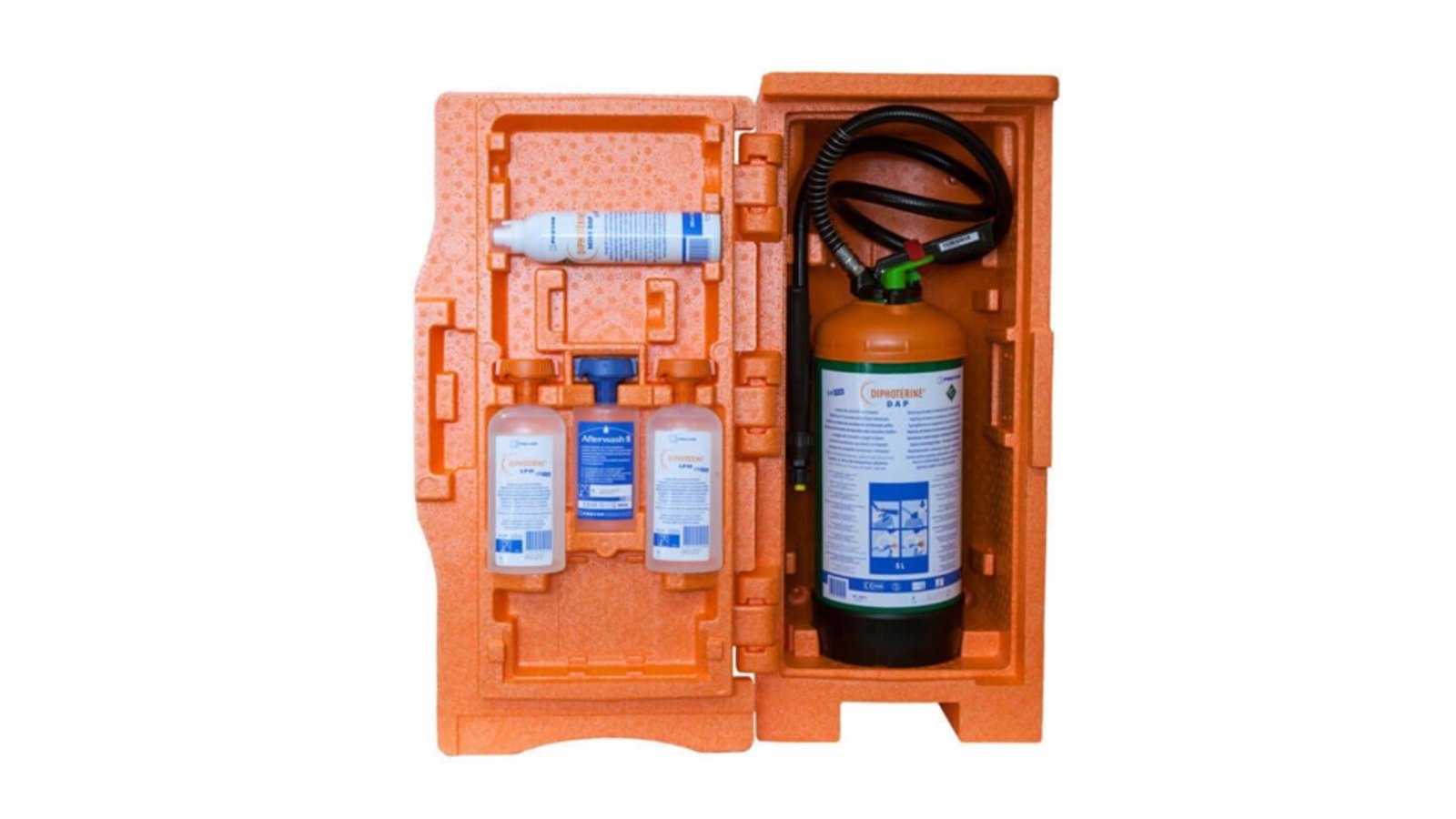
- Does each area have the right equipment for eyes, skin and whole body? An eyewash won’t deal with a full-body splash, and a body shower isn’t designed for eyes. Where there’s a whole-body risk, check there’s a body shower, plumbed-in or portable, within reach.
- Does your equipment meet EN 15154? Many people don’t realise there’s a European standard for emergency showers and eyewash, and that it covers portable units too. Parts 1 and 2 cover plumbed-in body showers and eyewash. Part 3 covers non-plumbed (self-contained) body showers and Part 4 non-plumbed eyewash units: among other things, units must start working within 5 seconds of being activated, and the standard sets requirements for the washing solution and minimum volumes. Ask your supplier which part each unit meets. Diphoterine® systems meet Parts 3 and 4.
Check it’s ready
- Is it in date, stocked and checked? Name who checks it and how often, and record it. Plumbed-in showers and eyewash also need regular flushing and flow checks.
- Do people know what to do, during and after? Short training and clear signage at each point make a difference when it counts, including removing contaminated clothing while washing. After any chemical splash, the person should seek medical advice.
Check it against the evidence
- Have you reviewed your choice of washing solution recently? A meta-analysis of 800 published papers found that what you wash with was the biggest factor in how chemical injuries turned out, more than how quickly washing started. Read the evidence
What next?
If any answer gave you pause, you’re not alone. Chemical first aid is easy to set up once and leave unreviewed.
You don’t have to change everything at once. Starting with your highest-risk areas, such as dosing points, cleaning-in-place (CIP) systems and bulk tank offloading, is a practical first step.
Our team can talk it through with you on a 30-minute call: the chemicals you handle, where the risks are, and what would suit your site.
Download a printable copy of this checklist
Diphoterine® solution is a CE-marked Class IIa medical device, supplied in Great Britain by Diphex Solutions Limited, UK Responsible Person. Manufacturer: Prevor, France. Always read the instructions for use. After any chemical splash, seek medical advice.
