

37 in 100 vs 1 in 100: the evidence on chemical first aid
A meta-analysis of 800 published papers compared water and saline with Diphoterine® solution. Here is how big the difference was.
How big is the difference?
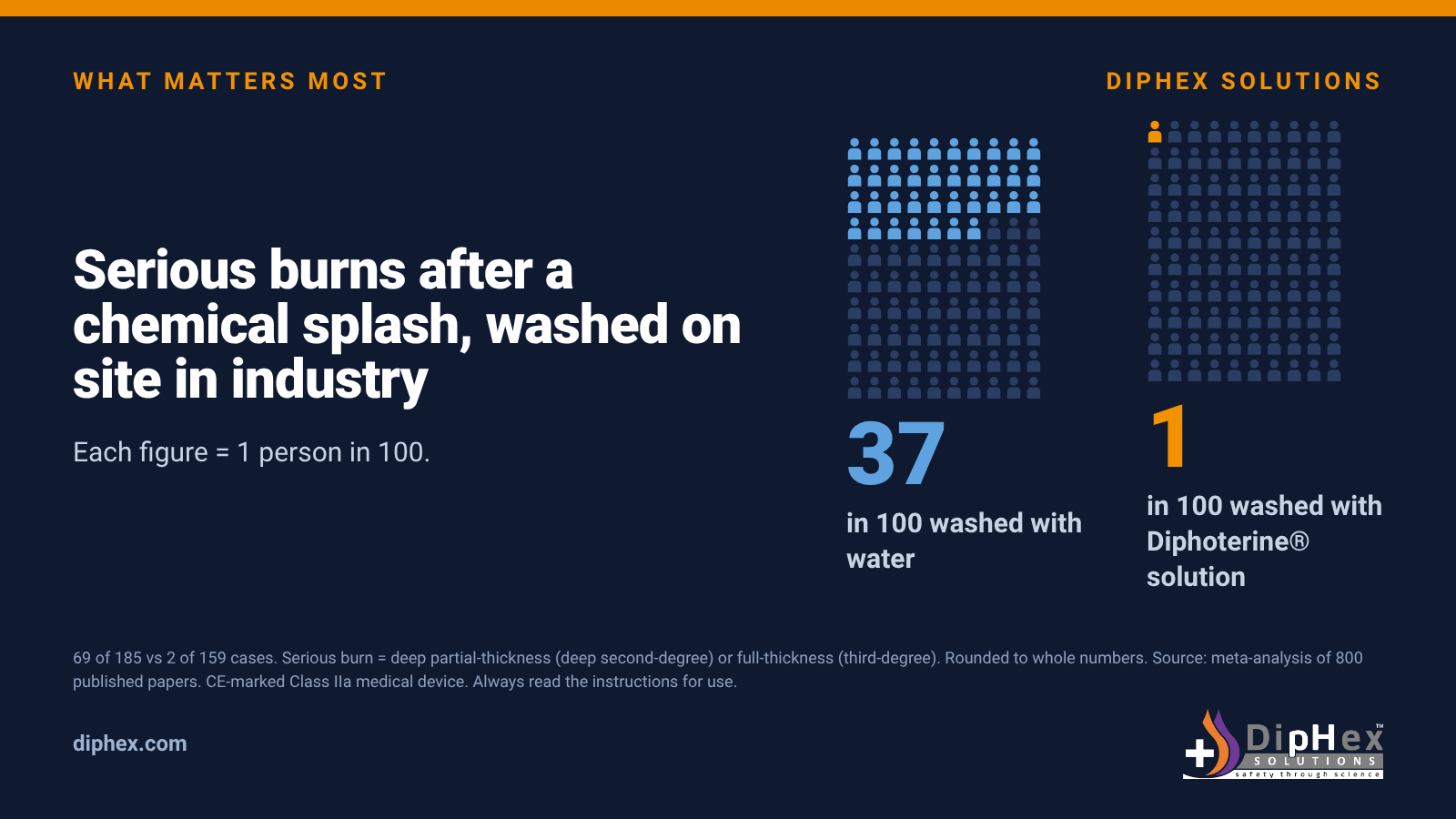
A meta-analysis compared cases washed with water or saline with cases washed with Diphoterine® solution. In industry, where washing started on site:
| Outcome | Water or saline | Diphoterine® solution |
|---|---|---|
| Serious burns | 37 in 100 | 1 in 100 |
| Surgery or more than two weeks in hospital | 38 in 100 | 0 in 100 |
For eye splashes:
| Outcome | Water or saline | Diphoterine® solution |
|---|---|---|
| Eye injuries needing intensive follow-up care | 44 in 100 | Fewer than 4 in 100 |
| Average eye pain score after washing (0 to 10) | 5.7 | 1.7 |
A serious burn means a deep partial-thickness (deep second-degree) or full-thickness (third-degree) burn. For skin, intensive follow-up care means surgery such as a skin graft, or 15 days or more in hospital; for eyes, surgery or 7 days or more. Each result comes from the studies that reported that outcome, so group sizes differ. Figures are rounded to whole numbers.
Results with Diphoterine® solution were also more consistent across studies than results with water. The review’s authors suggest this means it is less affected by the circumstances of the splash, such as the type of chemical or how long it took to start washing.
Where the numbers come from
The findings come from a meta-analysis of 800 published papers, carried out for the renewal of Diphoterine® solution’s CE certification as a Class IIa medical device. Meta-analyses sit at the top of the hierarchy of medical evidence, because they combine the results of many studies rather than relying on one.
- Papers were drawn from medical and scientific databases, including PubMed and ScienceDirect.
- Studies were selected using recognised methods (PICO and PRISMA).
- Two independent physicians selected and scored the studies, with a third resolving any disagreement.
- The statistics were reviewed and validated by an expert from the Department of Biostatistics and Epidemiology at the Paris Hospitals, and by the head of the meta-analysis unit at Fribourg Hospital.
As part of that certification, the following claim was certified by GMED (Notified Body 0459) under the EU Medical Device Regulation:
“Diphoterine® solution prevents or reduces the severity of chemical injuries more effectively than water when used for immediate or delayed washing.”
Download the one-page key results (PDF)
Diphoterine® solution is a CE-marked Class IIa medical device, supplied in Great Britain by Diphex Solutions Limited, UK Responsible Person. Manufacturer: Prevor, France. Always read the instructions for use. After any chemical splash, seek medical advice.
